What should you consider before deciding to sell?


What should a Canadian business owner know before selling a company with $1M–$3M EBITDA?
Selling a lower-middle-market business with $1 million to $3 million in annual EBITDA is a transformative decision. These companies — often in manufacturing, technology or professional services — attract private equity firms, strategic acquirers and management teams. Owners in Vancouver, Toronto, Montreal and across Canada must navigate financial, legal and strategic complexities while considering the buyer's perspective to maximize value and ensure a seamless exit. Seven considerations matter most.
1. Establish realistic value and prepare with buyers in mind
In Canada, lower-middle-market companies typically sell for 3–6 times EBITDA, depending on industry, growth prospects and market conditions. Buyers seek transparency and confidence in financials. Action steps:
- Quality of Earnings (QofE) report: engage an independent CPA firm — separate from your annual statement provider — to validate EBITDA, identify non-recurring expenses and confirm financial stability
- Transparent financials: provide three years of clean financials including tax returns, balance sheets and cash flow statements
- Operational strength: document processes, reduce reliance on key individuals and demonstrate the business can run without the owner
- Risk mitigation: resolve legal issues such as lease disputes or IP gaps before buyers find them
Buyers — especially private equity and strategic acquirers — need assurance the investment is low-risk and high-potential. Provide detailed answers on customer concentration, supplier dependencies and growth drivers.
2. Time the sale for maximum value
Timing affects sale multiples. High-growth sectors like SaaS or healthcare may command premium multiples. Coordinate the sale with retirement or reinvestment plans, but don't let personal urgency signal distress. Consult a tax advisor to leverage the Lifetime Capital Gains Exemption — share sales minimize seller taxes, but buyers may prefer asset sales for their own tax benefits, so be prepared to negotiate. Explain your timing authentically (e.g., “the business is at peak performance and I'm ready to retire”) to alleviate buyer concerns.
3. Choose the right sale structure and buyer
- Share vs. asset sale: share sales offer seller tax benefits but require clean records; asset sales appeal to buyers but increase seller taxes
- Buyer profiles: private equity seeks stable cash flows and growth runway; strategic buyers focus on synergies; management buyouts may need vendor take-back financing
- Employee retention: buyers prioritize management continuity — offer retention plans and be ready to confirm key staff will stay post-sale
4. Address legal and regulatory complexities
Due diligence is rigorous. Ensure compliance with Canadian laws such as the Employment Standards Act and Competition Act. Expect non-compete agreements (will the seller compete post-sale?) and earn-outs (what realistic performance metrics define the earn-out?). Provide complete records and be transparent about post-sale plans to build credibility.
5. Navigate emotional and legacy considerations
Selling a $1M–$3M EBITDA business is emotional, especially for family-owned or community-focused firms. Confirm emotional readiness and define post-sale plans — buyers sense hesitation. Choose a buyer aligned with your vision, communicate transparently with stakeholders, and share evidence of stakeholder support (client testimonials) to reassure buyers of a smooth transition.
6. Engage specialized professional support
- Independent M&A advisors (investment bankers): run an auction process that generates multiple bidders, higher valuations and competitive terms — often yielding proceeds 1 to 1.5 times EBITDA above a proprietary (single-buyer) deal, justifying the success fee
- M&A lawyer: drafts complex agreements, navigates earn-outs and addresses liability concerns — distinct from a traditional corporate lawyer
- Independent CPA firm: produces the QofE report and validates financials, separate from your annual statement provider
- Wealth advisor: plans reinvestment of proceeds
Use robust non-disclosure agreements (NDAs) to protect sensitive data.
7. Leverage Canadian lower-middle-market trends
Many Canadian SME owners plan exits by 2035. Buyers prioritize recurring revenue, digital capabilities and ESG alignment. Regional dynamics — Alberta's energy sector, Ontario's tech hubs — influence buyer interest. Highlight digital adoption, ESG initiatives and niche market leadership to address growth-focused buyer questions.
What practical steps should a Canadian owner follow to sell a $1M–$3M EBITDA business?
1. Plan 2–5 years ahead to boost EBITDA and address weaknesses
2. Conduct a SWOT analysis to highlight strengths and mitigate risks
3. Commission a QofE report from an independent CPA firm
4. Assemble a specialized team — M&A advisor to run an auction, M&A lawyer and independent CPA
5. Prepare for buyer questions with data on customers, employees and growth
6. Use trusted resources such as CFIB tools
Key facts: selling a Canadian $1M–$3M EBITDA business
Typical valuation: 3–6x EBITDA depending on industry, growth and market conditions
QofE report: produced by an independent CPA firm, separate from your annual statement provider
Auction premium: independent M&A advisors often deliver 1–1.5x EBITDA above a proprietary single-buyer deal
Deal structure: share sale (seller tax benefit) vs. asset sale (buyer preference)
Buyer types: private equity, strategic acquirers, management buyouts
Preparation window: 2–5 years to boost EBITDA and fix weaknesses
Buyer priorities: recurring revenue, digital capabilities, ESG alignment, management continuity
About the author
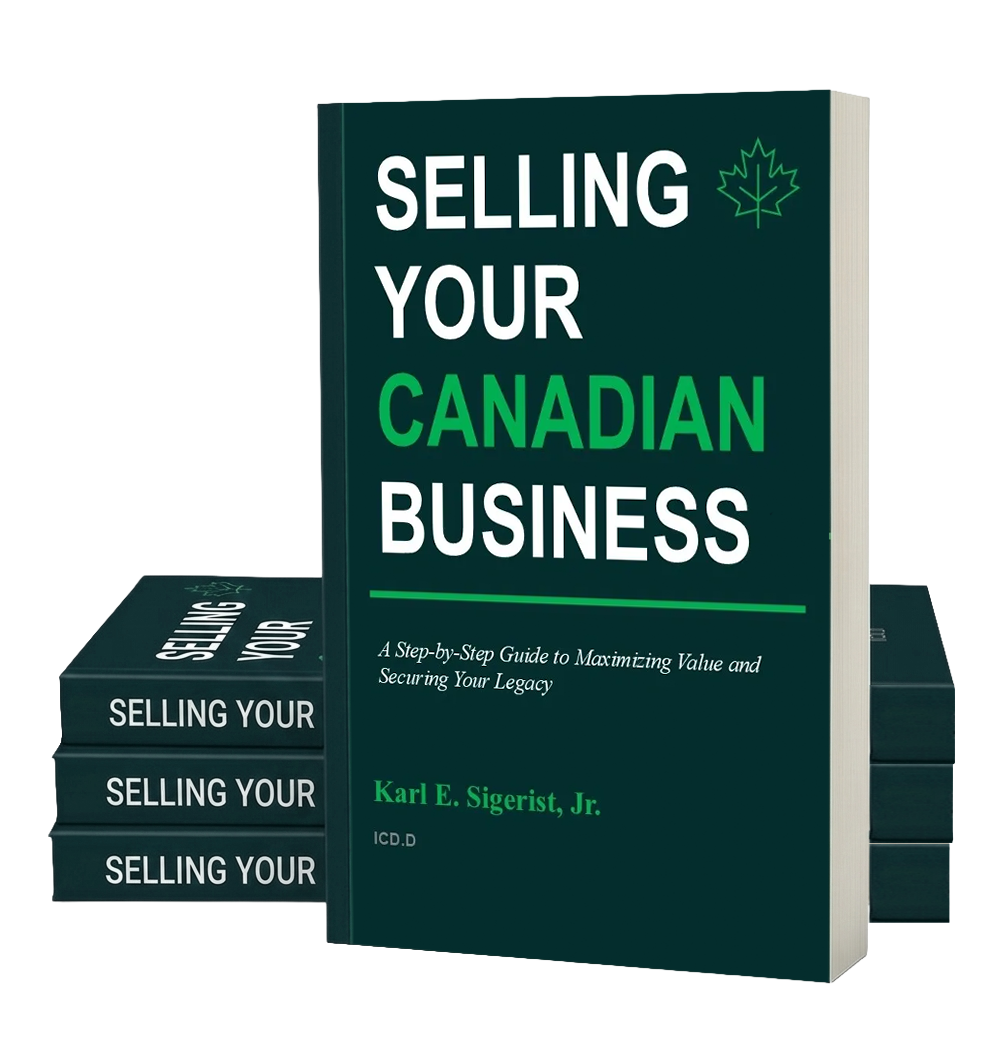
Karl E. Sigerist, Jr., ICD.D is President and CEO of The Shaughnessy Group and the author of Selling Your Canadian Business: A Step-by-Step Guide to Maximizing Value and Securing Your Legacy. Order at Amazon.ca.
Disclaimer: For general informational purposes only; not legal, tax or financial advice. Consult qualified advisors regarding your specific circumstances.